





Golden Glow
3 tbsps Cacao Love
2 tbsps local honey
1 tbsp ghee and a pinch of turmeric
One of our favourite ways to drink cacao.
Pour in your hot water, gently warm, and you’ve got liquid gold.
Simply add your ingredients to a pan, and warm on a gentle heat, stirring continuously until the cacao melts.
(You can also add your ingredients to a blender and whizz for two minutes.)
Pour into your favourite mug, spend a moment in contemplation, give thanks, set your intention and savour!


3-2-1 formula
Golden Glow
3 tbsps Cacao Love
2 tbsps local honey
1 tbsp ghee and a pinch of turmeric
One of our favourite ways to drink cacao.
Pour in your hot water, gently warm, and you’ve got liquid gold.

Island Velvet
3 tbsps Cacao Love
2 tbsps coconut sugar
1 tbsp coconut cream and a pinch of vanilla powder
Pure comfort.
Add your hot water, stir slow, and let your whole body soften.

Heart-blood Fire
3 tbsps Cacao Love
2 tbsps maple syrup
1 tbsp coconut oil and a pinch of cinnamon and chilli to taste
Time to wake up every cell in your body.
Pour in your hot water, warm through, and feel the heat rise from the inside out.

Chai Temple
3 tbsps Cacao Love
2 dates
1 mug hot masala chai
Blend till it’s thick and frothy.
Sweet, spiced, sacred, delicious.

Unabashed Pleasure
3 tbsps Cacao Love
2 tbsps hazelnut spread
1 mug warmed coconut milk
Warm until it’s smooth, thick, and indecent.
If you’ve ever wanted dessert for breakfast (with zero guilt), this is it.
We suggest 15g to 25g as a ‘daily dose’ as part of a morning ritual.
Personally, we find that this amount strikes the perfect balance between experiencing the warming benefits of the drink, without overstimulation.
These days, we don’t weigh our cacao at all, and use a simple 1, 2 or 3 tbsp measure of how strong we would like to create our drink for the day.
Here is a simple guide to get started:
42g is often shared in circles as a ceremonial dose. This measure is a part of the contemporary cacao movement with its origins on Keith Wilson’s porch, where he shared his ceremonies.
For Gavin, who has a sensitive constitution, 42g is quite strong. He intuitively served about 25g per person in his early ceremonies, without any noticeable reduction in cacao’s heart-opening and transformative effects.
There are no fixed dosages for how much cacao to consume, and the stimulating strength of cacao varies significantly from bioregion to bioregion.
Your relationship with cacao is an intimate and personal journey.
We love drinking cacao every day and understand its compounding health benefits, but we also have periods where we drink it once a week, or every other day, based on how our bodies feel.
We encourage everyone who begins a relationship with cacao to experiment and explore how different dosages feel in the body.
On the upper end of the dosage scale, the Kuna people of Panama consume up to 75g of cacao daily, and have been documented to enjoy statistically significant health benefits that are lost once they move to the city, and away from their traditional diet. Although there are undoubtedly multiple lifestyle factors at play here, their traditional cacao drinks appear to be a significant contributor to their overall longevity, compared to relatives who move away from the traditional foods.
Yes, it does! However, it functions in a very different way than the caffeine in coffee.
Cacao contains all of the xanthine alkaloids, including a bioactive amount of caffeine. A cacao bean is around 0.2% caffeine, meaning that a 30g serving contains just over 60mg of caffeine: a little more than a mug of tea, which averages around 50mg, and less than a mug of brewed coffee, which averages around 95mg.
Theobromine is the most plentiful of the three xanthine alkaloids in cacao, making up just over 1% of the bean’s total weight. Some evidence suggests that theobromine reduces the stimulating effect of caffeine, though it does not alter its uplifting impact on mood or its diuretic effect on the kidneys.
Many long-term coffee drinkers report feelings of depletion, and look for alternatives to reduce their dependence on its activating effect. Cacao has often been used successfully in this quest, and it may be this effect of theobromine, reducing caffeine’s stimulatory effects while still allowing a xanthine high, that accounts for its success.
Cacao is often marketed as a coffee replacement, and sometimes this leads to an oversimplified framing of caffeine as ‘bad,’ and to the mistaken claim that ceremonial grade cacao contains no caffeine.
We believe that no compound is inherently bad; what is more important is the mindful and respectful relationship we develop with the plant as a whole.
As we’d recommend when getting to know any powerful plant medicine, start small and increase your dosage as your connection, sensitivity and relationship to cacao develops.
Cacao is naturally self-regulating, and too strong of a dose is uncomfortable in a similar way to drinking too much coffee is, inducing mild nausea and agitation. As a result, the temptation of drinking more and more doesn’t really exist.
Cacao is not physically addictive, however it does have mood and behaviour enhancing properties that might make drinking it each day desirable.
For us, there’s no shame in the daily cacao game! Cacao is a powerful spirit and sacred friend in our everyday lives.
Yes, absolutely.
There is undeniably a beauty to the slow ritual of preparing cacao on the stove that can be expanded upon by offering prayers, and singing as you stir.
Though often we prepare cacao in this way, we don’t agree with the taboo that seems to have emerged in the cacao movement against using a blender. What is important, as in all things, is the presence and intention you bring to what you do.
Some ceremonialists advise against sweetening cacao, emphasising the importance of experiencing the natural bitter profile of the medicine. We respect this view, although as advocates of the sensual, we also delight in the balance of a drink prepared with a natural sweetener.
We love to add honey, maple syrup, panela and jaggery to our recipes.
There is also historical precedent for sweetening cacao: the sixteenth-century Florentine Codex details a Mexica preparation that combines cacao with wild honey.
Adding sweetness or honey connects to many Indigenous, African, and African American magical practices, symbolising the attraction of sweet things into one’s life.
When we drink cacao, our gut microbes convert larger molecules, like flavonoids, into smaller polyphenols, like flavanols. The condition of the gut microbiome plays a significant role in how effectively these compounds are absorbed and then utilised by the body.
This is a reciprocal relationship: polyphenols not only improve gut health but also influence the composition of the gut microbiome. They promote the growth of beneficial bacteria while inhibiting harmful ones, creating a healthier and more balanced gut environment.
A healthier microbiome enhances the body’s ability to metabolise and absorb polyphenols, creating a positive feedback loop where both the beneficial compounds in cacao and the gut microbes support each other’s health-promoting roles.
Sugars and starches have the opposite effect to dairy, significantly enhancing the absorption of these beneficial compounds.
Our invitation therefore is to indulge in a moderate amount of natural sweetener, both for pleasure and to support the absorption of cacao’s beneficial compounds.
We generally don’t recommend using dairy products with cacao, as some research suggests that its consumption can interfere with the gut’s ability to absorb cacao’s polyphenols that promote the growth of beneficial bacteria in the microbiome.
For an extra creamy elixir, a high-quality plant milk or a teaspoon of coconut oil will give a rich, velvety texture to your drink.
Many ceremonialists teach that you must never use boiling water when preparing cacao, although we haven’t been able to find any research that would explain why this advice ought to be given.
We suspect it might have come from the raw food movement, which advocates keeping temperatures below 42°C, as heating beyond this point can denature enzymes and degrade nutrients.
In traditional methods of toasting cacao, such as on a comal, a flat griddle typically made of cast iron, steel, or clay, temperatures are usually in the range of 100°C to 120°C.
Although some nutrient loss is inevitable, cacao toasted in this temperature range will keep 90% of its flavanols intact.
In fact, the only reason we are aware of not to use very hot water is that your drink will take longer to cool down before you can enjoy it!
As you prepare your cacao, you may notice that its visual appearance is not regular. Often there are swirls, ripples, or paler-coloured layers running through the cacao. This is called bloom.
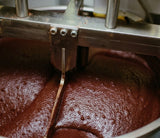
After the cacao has been ground to a paste and poured into moulds, it cools to its stable, final temperature.
As the temperature drops, the liquid cacao butter is slowly squeezed out of the solidifying matrix of cooling cacao, giving the characteristic patterning we often see.
Once the cacao is melted into a drink, everything reconstitutes, and so the effect is only cosmetic.
We love to look for shapes, symbols and patterns in cacao’s bloom!
If you are preparing cacao for a group, you can scale up our 3-2-1 formula in a large pan, or in batches using a blender.
If you will be using a flask to carry your cacao, first establish how many serving cups your flask takes.
Fill one of the cups you will use to serve the cacao with water, and pour one cup after another into your empty flask, until it reaches the recommended fill level.
For example, our 1.5 litre flask takes 10 of the serving cups we use in our ceremonies.
Using our formula, we would factor up the following recipe by 10 to make enough servings to fill the flask:
In this example, we would add this quantity of ingredients plus 10 of our serving cups of water to a large pan, and warm. Once the cacao is fully melted, it is ready to serve, or to pour into the flask for later.
Cacao stays warm in a good flask for at least 8 hours, and you will now have 10 perfectly balanced servings for your circle.
Whereas we don’t measure our doses by metric weight, preferring a more intuitive tablespoon measure, you can assume that 3 tbsps of cacao will weigh around 33g.
When it comes to serving the cacao, if somebody needs a more gentle dose, you can fill the serving cup accordingly, working on the premise that a full cup will contain 33g, and a half cup around half of that.

Our morning cacao ritual is the foundation of everything we do, in love and in our lives together.
We’d love for you to experience this too, so here’s 20% off your next order so you can start your day from the heart.
Unlock My 20% CodeThe preparation of your cacao is a ceremony in itself. To create a mindful space to prepare cacao, spend a few moments clearing any clutter and wiping down your workspace in the kitchen before you begin.

During the warming and melting process, you have a precious opportunity to stir your intentions, your prayers, and your songs into your elixir. Here you may literally enchant your elixir: putting your heart song into your cacao. We offer the prayer we use in our preparation ritual for you to use, or to inspire your own heartfelt words.

I call upon you, Sweet Mother Cacao, to watch over this ritual of preparation. From your sacred seeds, we craft this elixir with your name on our lips, and your love in our hearts. May this drink be a vessel of healing, a channel of inspiration, and a gift of devotion.

My prayer deepens as this gentle flame slowly warms your body. Thank you for this taste of heaven, this melted bliss, this Holy Ananda. I take a moment to honour the work of the many hands that have made this moment possible.

May your blessings flow through the lives of all the families, farmers and forest guardians responsible for bringing us the gift of this medicine. Open our hearts, so we may savour the beauty of your grace. We prepare this offering in complete service to your love.
With love and hearts full of cacao,
Diane and Gavin x


A gift for you
Experience the life changing magic of cacao at home with an hour long ceremony.


