



How is cacao made?

The process of creating cacao is magical and awe-inspiring when we consider the alchemical journey these seeds take before reaching our cups in ceremony.
The seeds of the fruit are fermented, toasted, and then ground to a paste.
These are the seeds that aren’t destined to sprout new trees, but instead to bring new life to our hearts and hands, and carry new brightness to our prayers.
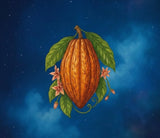
The tough, protective exterior of the cacao pod means that they don’t naturally open themselves up, but instead rely on a collaboration with humans and animals, such as monkeys, squirrels and bats.

Planting
Cacao evolved beneath the rainforest canopy, and its glossy, dark green leaves are angled to catch thin shafts of light that pass through the ceiling of the forest.
Below ground, the cacao tree sends down a taproot that joins fungal mycelia to draw up minerals the tree cannot reach alone.
Young cacao trees are fragile, and easily damaged by high winds, so the canopy provides shelter as well as shade.
In an unusual phenomenon known as cauliflory, cacao flowers and pods grow directly out of the main trunk and large branches of the tree.

Pollination
A mature tree produces up to 100,000 flowers every year.
Only a small number of these flowers are ever pollinated, and most of those wilt and drop a few weeks later.
Less than 1 in 1,000 cacao flowers become a pod!
The flower’s anatomy is governed by the number five: five petals, five sepals, five sterile stamens, five fertile stamens, and an ovary in five divisions.
The flowers open overnight and are receptive by morning, when the pollinating midges rise up from the damp forest floor.
The tiny white flowers are scentless to us, but yield 78 aromatic compounds, attracting the pollinators to their blossom.

Harvesting
Each tree produces 20 to 30 pods a year, and each mature pod holds 30 to 50 seeds.
Growers walk the orchards daily, cutting each pod as it reaches ripeness.
Harvesting is a saunter through the forest: the pods ripen at different times, so it takes a keen eye and full presence to know which fruits are ready.
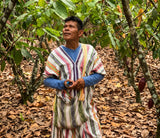
Opening the ripe pods is a labour of love performed by the whole Asháninka community together: the pods are split, and the pulp and seeds lifted out of the husk by hand.

Fermenting
During fermentation, the sugary white pulp surrounding the raw beans is digested by yeast and bacteria, producing the chemical precursors to hundreds of flavour compounds that develop during roasting.
A single fermented seed holds over 500 active compounds, including at least 462 distinct volatiles that contribute to both flavour and aroma.

Drying
After fermentation, the beans are laid out on mats for up to 2 weeks, raked and turned regularly by the growers.

Roasting
They arrive at the workshop, where they are roasted at low temperatures, adding more complexity to the cacao’s flavour, while protecting the delicate compounds that high heat can destroy.

Winnowing
This process separates the papery husk from the inner nibs.
A strong current of air blows the inedible shells from the heavier parts of the seed.

Grinding
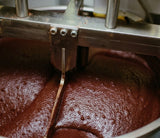
Grinding is complete once a particle size of under 20 microns is reached.
This texture is just beneath detectability by the tongue, which is why the finished cacao tastes so exquisitely smooth, and why it dissolves easily in water, without grit.
The cacao butter in the seed is naturally released during this process, forming a barrier of protection around the delicate polyphenols, preventing oxidisation.

Moulding
Slowly, it returns to room temperature, at which point it is packaged and shipped to our dedicated commercial kitchen in the UK.


Ceremonial Grade Cacao
Ceremonial grading represents a set of values, rather than a branded standard.
At Cacao Love, we deeply value that:
From seed to ceremony, we only work with Indigenous cacao growers and producers.
Not only does the entire production process happen in its country of origin, but every step is managed by the community, in a community-owned facility.
The families who grow this cacao live entirely from their forests in the Central Highlands of Peru, on small family plots inside a diverse forest ecosystem.
They belong to the first all-Indigenous cacao co-operative in Peru, which became the template other organisations used to build their own.
The growers weigh their own sacks of beans. They are paid in cash on their homesteads, and they set the asking price themselves. We don’t negotiate prices with the families we work with.
Jeny Bustamante Rodríguez (pictured here second from right) and her production team are part of a new wave of Indigenous women leading Peruvian cacao production.
Pasonki — thank you! — for being part of this story.
