





5,000 Years In The Forest
Asháninka culture and cacao in the Selva Central
For over a decade, we have sourced cacao from Asháninka growers in Peru’s Junín province, and more recently through the country’s first all-Indigenous cacao co-operative.
We are honoured to share some of their story here: Asháninka culture, survival through genocide and displacement, and the role cacao now plays in rebuilding life in the forest that’s been home for millennia.
Interspersed with anthropological research are first-hand interviews with the growers we work with, conversations that took place during two trips to the Central Highlands in 2024.
For many of the farmers we spoke to, the cultivation of cacao represents a stark pivot from a recent history of exploitation and terror toward autonomy and community solidarity.

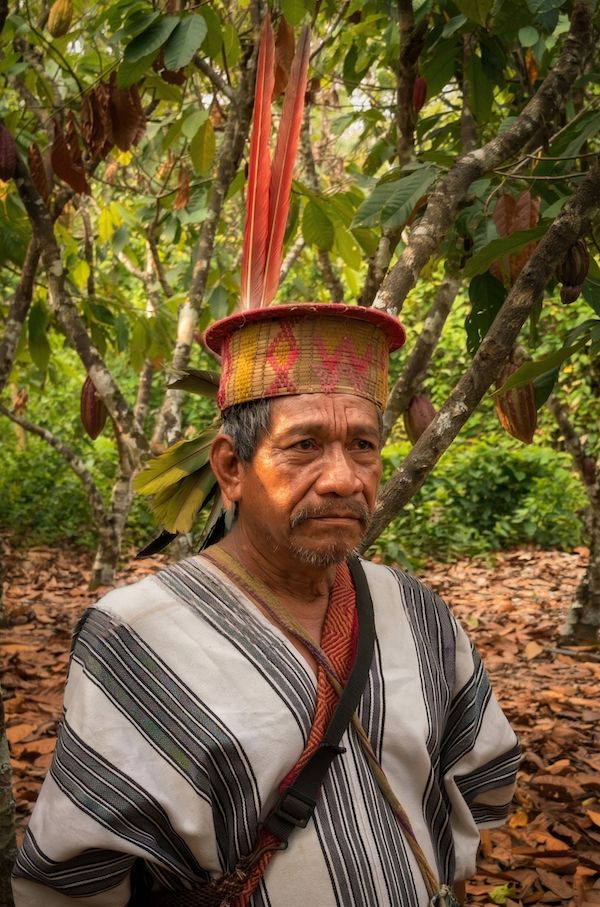
Wilfredi Ríos Pancho, a community chief, explains to us what cacao means to him:
Cacao, for me, means life, because it’s also a plant that captures oxygen. It brings change for our families, because with cacao, we can now educate our children. Thanks to cacao, many people have changed their lives. Many Asháninkas are now working. They have sustenance in their home, gathering with their family. Before, we didn’t have this, because there was little work, and there was also exploitation.
The forest as kin
The significance of cacao cannot be separated from the Asháninka cosmology within which all life in the forest is understood.
The most powerful spirits in the cosmos are called the Tasórenci: gods who possess the ability to bring about transformation through their breath, and who form a pantheon that governs the universe. At the top of this hierarchy is Pává, the most powerful of the Tasórenci, revered as the father of all creatures.
As an oral tradition, there are variations in the stories of how these high beings came into existence. In some traditions, there is not a figure of a creator but a transformative hero, Avireri, who changed humans into animals, plants, mountains, and rivers.
According to some accounts, Pává was born when Kashiri, the moon, who is male, mated with an Asháninka woman. She gave birth to Pává, the sun. The moon, therefore, is the father of Pává, and lived on earth with the sun, before they both rose to the sky.
This deep spiritual interconnection extends to the physical environment.
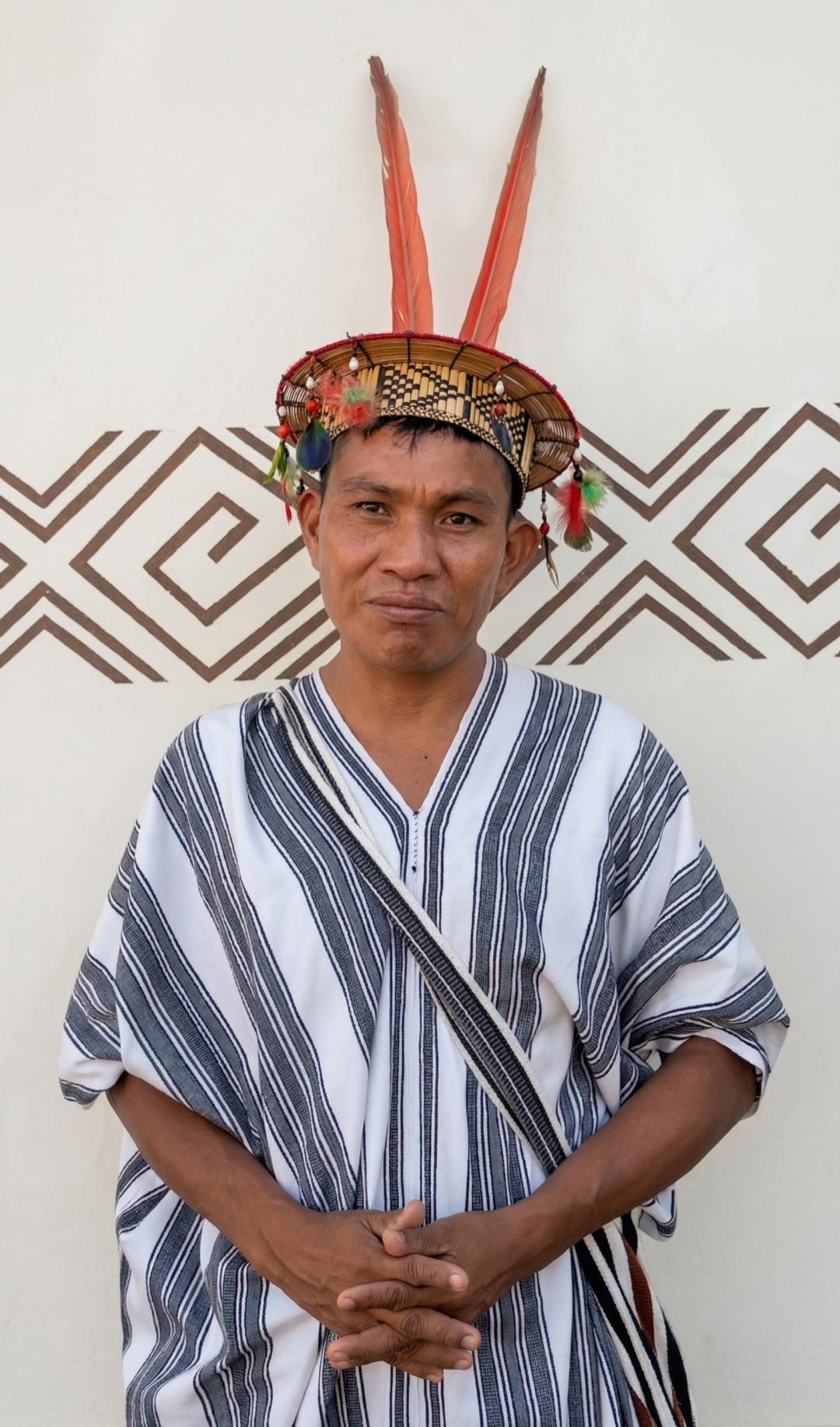
Ángel Pedro Valerio, an Asháninka Indigenous leader, explained to us:
The forests, the bush and the trees mean a lot to us. They are like human beings. They also have life, and when we enter the forest, we connect with them. We have beliefs that many of the trees, animals, and birds are like people, brothers of ours, and if these brothers ever disappear, it will affect us too.
The rhythm of the forest
The Selva Central is the central jungle region of Peru, the area where the eastern Andean foothills drop into the Amazon basin. This is the heartland of Asháninka territory, where they have resided for at least 5,000 years.
The Asháninka are one of the largest Indigenous groups in the Amazon basin. They are organised as a network of autonomous communities, a political structure that has sustained their resilience across centuries.
On our last trip to the Junín province, we learned from the families we stayed with that many communities have chosen to remain uncontacted in the forest. When they need specific items such as machetes or clothing, they travel downriver and exchange labour in the cacao orchards for tools, before heading back to their villages.
This traditional kinship and way of life has been severely disrupted by decades of violence, particularly during the internal armed conflict of the 1980s and 1990s. The arrival of the Shining Path forced many Asháninka to abandon their ancestral homes.
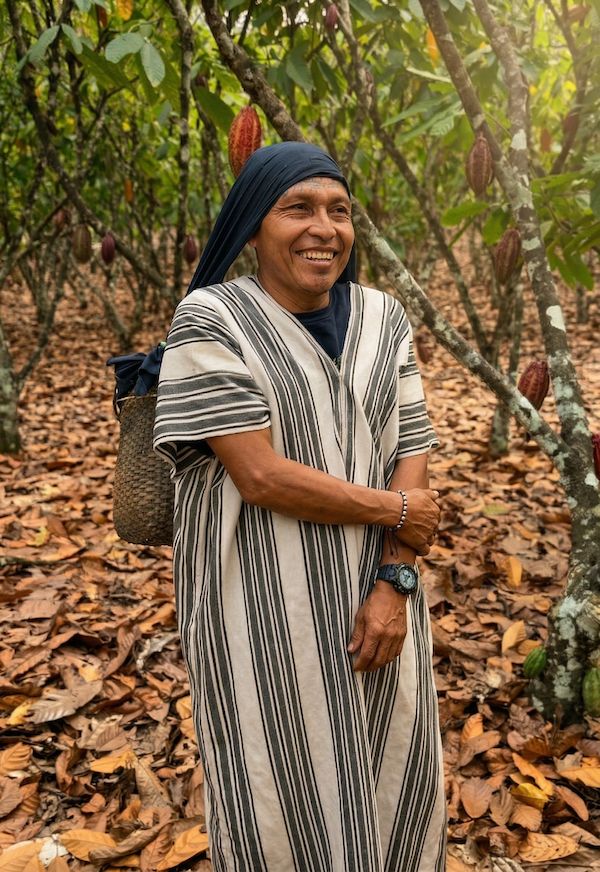
Fernando Sánchez Pérez, a cacao farmer who survived the conflict, recalled the sheer devastation that displaced his people:
I mean, my dad died, my family died, my brother died. A lot of them died because of the subversion. They killed you just like that. Point-blank. They killed the healthy, the sick, so we figured it was better to leave this behind.
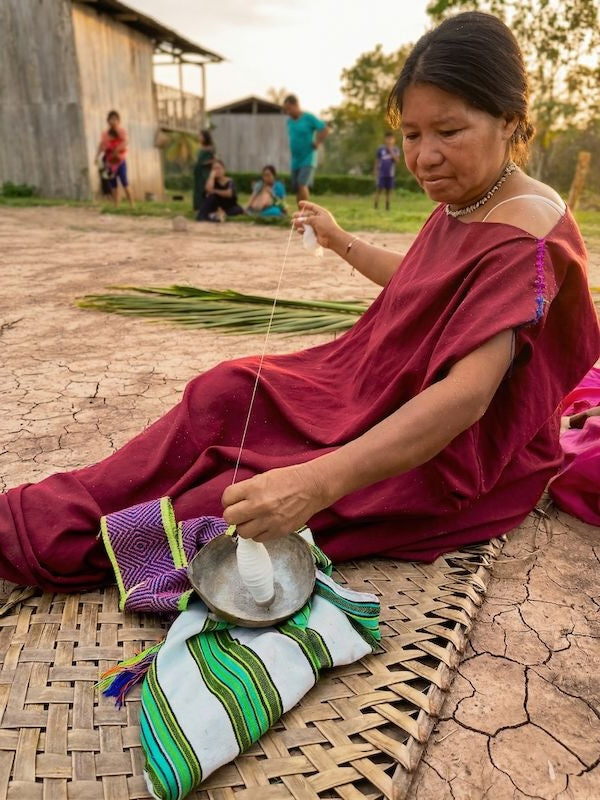
Woven identity
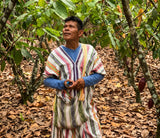
Asháninka people are immediately recognisable by their traditional woven garment, known as a kushma, a word of Quechua origin, and one of many examples of the long exchange between Asháninka and highland cultures.
In their own language, the garment is called kitharentsi, a word that refers to the robe, the cloth, and the loom it is woven on.
Distinctive among lowland South American peoples, the Asháninka have a long tradition of woven clothing, and traditional lore credits the daughters of Pává with teaching Asháninka women to weave and to make the kitharentsi.
This kind of adaptation is nothing new. The Asháninka have always absorbed useful elements from the cultures around them, adopting metal tools through Inca-era trade, borrowing the word kushma from Quechua, and shifting their settlement patterns in response to changing conditions.
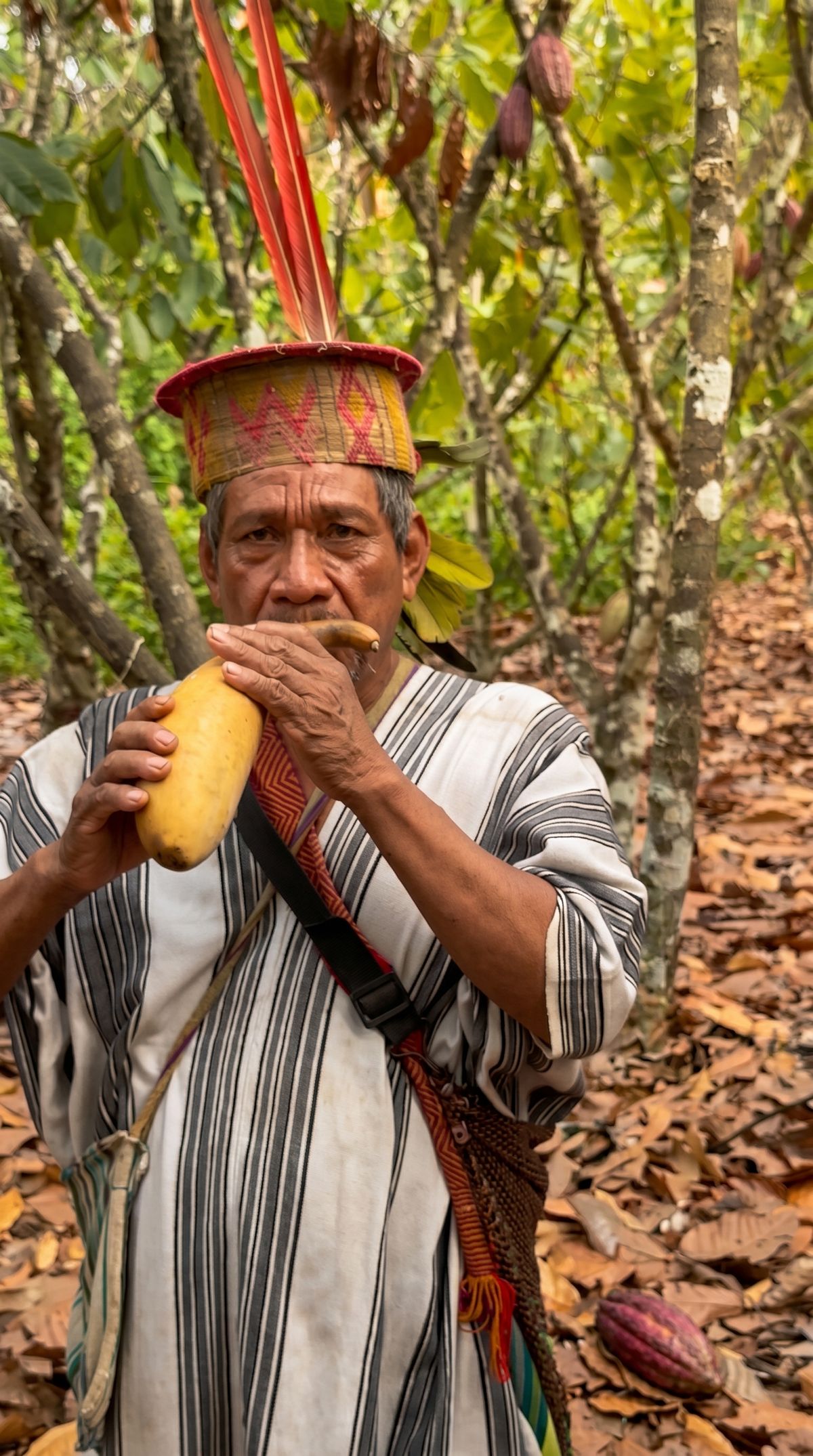
Wilfredi Ríos Pancho emphasised the enduring importance of these items:
Our grandfather used the kushma, zarato, and crown. That is our symbol. Our symbol of the Asháninka: the kushma. The crown is like clothing. Since we are Indigenous, that’s why we use the crown. Sometimes now, people are ashamed, right? But we should not forget moving forward. We must continue our customs.
A crossroads
When we visited the families who grow our cacao, the boat ride was about six hours upriver from the nearest town.
When we stopped at villages near the town, almost everybody wore western clothes. The entire community were practising Christians, a fact that carries its own complex history, given that Christianity first arrived in Asháninka territory through Franciscan and Dominican missions that functioned as instruments of colonial control, and that the Asháninka famously expelled in the Juan Santos Atahualpa rebellion of 1742.
The further upriver we travelled, the fewer obvious signs of Christianity we saw, and the more people were still wearing traditional cloth. This gradient reflects the intensity of contact with the non-Indigenous world, and the different adaptions and accommodations each community has made in response to this.
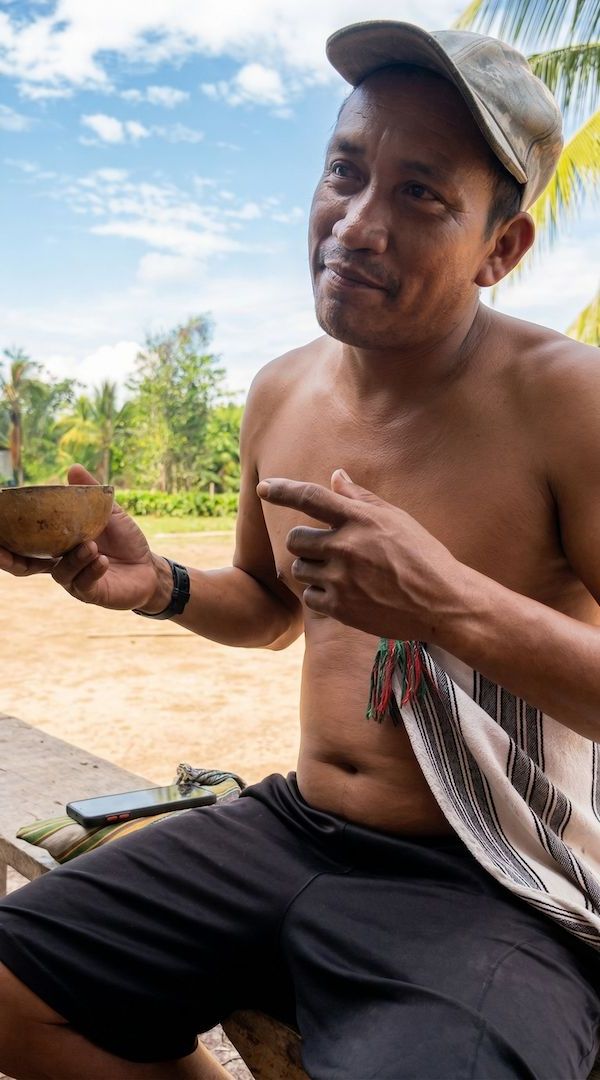
Claudio Vasco Manuel, a former president of a local cooperative, reflected on this intersection:
There is a crossroads, and a contamination has begun. Indigenous people have started to lose their customs. Sometimes the young men, the guys, they say, “No, I don’t like it, I want to dance.” But as for me, I was born for my people, and I will continue practicing my culture. I mean, we have needs: our children have to study. There is the difference: how we are going to work? Right there, the culture of our Indigenous people changes, but for me, I will not lose those things.
The sacred songs of the night
Kamarãpi, which means vomiting, or to vomit, is the Asháninka name for ayahuasca: both the drink and the ritual itself.
Ceremonies take place through the night, and unlike some Indigenous Amazonian groups where only the shaman drinks the brew, Asháninka consumption is much more egalitarian, with anybody able to participate. Kamarãpi is traditionally used for healing, but also for social cohesion, conflict resolution and personal spiritual guidance among family and friends.
The sole musical expression in an Asháninka ceremony is the sacred chant of the kamarãpi, sung unaccompanied. These songs facilitate communion with benevolent spirits of the forest, deliver healing, and give thanks to Pává, who bestowed the sacred drink upon his children, so that they could gain knowledge and learn how to live in harmony in the forest.
This botanical knowledge makes up a forest pharmacopeia, and prominently includes cacao.

Valerio explained how cacao has always been a vital medicine for the Asháninka:
Cacao served us as a medicinal plant. When a woman is pregnant and is about to give birth, this plant serves so she can give birth faster. It is very important to us, especially the bark. It serves us as medicine. We also consume the mucilage of the cacao. We make a smoothie out of it, like a juice.
The growing global demand for cacao with ethical, transparent origins is a recent chapter in a much longer story.
Visit our Substack to continue reading this Asháninka history of Indigenous self-rule in the Selva Central.

The Meaning of Asháninka
The word Asháninka is an embodiment of the sense of togetherness at the heart of its cosmology.
It is constructed from the stem -shaninka, meaning relative or kin, with a prefix that marks inclusivity.
It therefore translates as “our relatives, our family, or our people.”

Sacred Plant Medicines
An Asháninka home garden is a pharmacy.
Families make small clearings alongside their dwellings, where 66 different medicinal herbs are cultivated. They are called ibinishi, and are always grown from cuttings rather than seed.
Starter shoots pass along family lines, and so healing plants are considered to be a living inheritance, not something bought from a marketplace.

Amaerontsi
The traditional Asháninka crown is called an amaerontsi.
It is woven from palm leaves and other plant fibres from the forest, and then adorned with macaw and toucan feathers.
An amaerontsi smells as magnificent as it looks!
The crown is strung with aromatic forest seeds, such as ispingo, which releases a sweet, cinnamon-like scent as the wearer moves.

Chicha
Chicha is made by boiling and mashing yuca over an open fire.
The women preparing it chew generous mouthfuls, before spitting them back into the pot, the enzymes in their saliva initiating the process of fermentation.
Once cooled and strained, the chicha forms a delicious, slightly sweet yoghurt-like drink.

Pasonki!
By choosing Cacao Love, you are actively contributing to a larger movement that supports Indigenous-led conservation and sustainable agroforestry.
Together, we play a small role in supporting the self-determination of Asháninka people in the Selva Central, safeguarding the forest for future generations while sharing the sacred gifts of cacao with the world.
Pasonki — thank you! — for being part of this story.
